[SEARCH] ⇡ CLICK TO WAKE
►
[ CMD+K OR CLICK ]


Coming at you with dAIgest 7. Luckily our website doesn't run on PHP, otherwise we would probably be a bit tardy!
This week in bullet points:
Loads of topics under the radar, let us guide you through them all.
Either you lived under a rock or you are sipping from a coconut on a remote island if you missed the big event this week: the PHP exploits. Early on Wednesday, PHP published a post annotating that it found 2 critical exploits, CVE-2026-109618 and CVE-2026-109619. On the CVSS scale, both rated above 9 and had laid dorment in the PHP codebase for some time now. Much has been written on these exploits, the fallout and the fix, but for us something remains interesting. The exploits were found using automated source code auditing, assisted by AI tools. It resulted from the "Patch the Planet" research initiative, a joint effort led by OpenAI, Calif and Wiz. The bugs itself were found in low-level C runtime code, whilst analysing the memory lifecycle. These types of bugs are notoriously hard to find, because the code itself is idiomatically correct and does what it is meant to do. Rather, the defect stems from contradictions in how humans approach runtime execution. And this is where AI simply beats human auditors, because the mental model that an AI (specifically multiple agents) builds, is usually grounded in much more data points.
Another interesting event related to AI was the worldwide scramble to patch millions of web services. Because the exploit was immediately shared online, a lot of PHP users were scared of attacks. Attacks primarily driven by AI. This brought up an interesting argument, if AI can find and exploit vulnerabilities on its own at a rapid pace, how much danger are we really in?
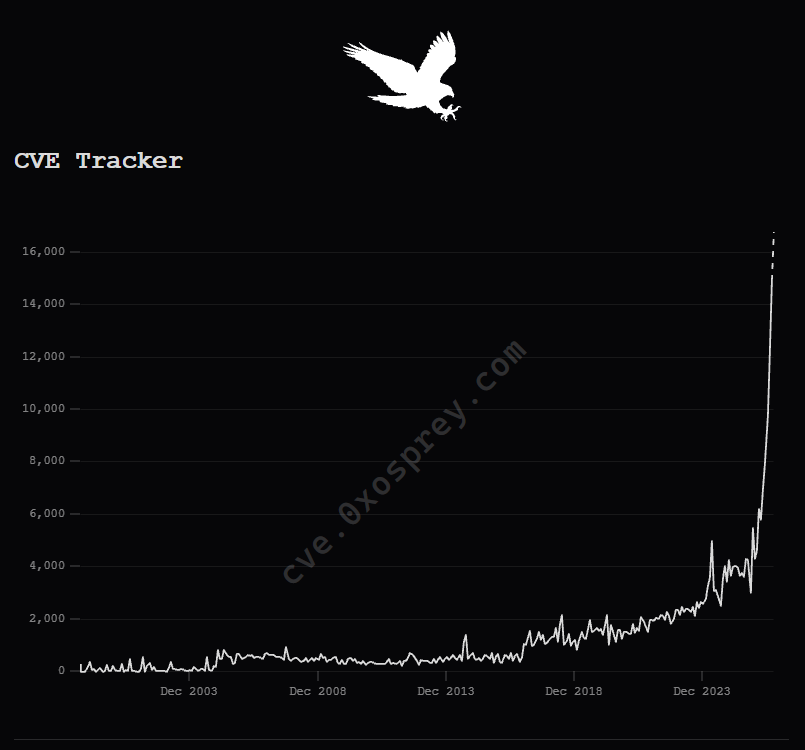
And that is exactly the question that people quickly answered by looking at CVE tracker. The amount of critical exploits found has skyrocketed this year, driven by the rise of AI agents and AI-assisted tooling. Given the rise this month, some even speak of "Black October". And now you could argue, if AI can find it, it can patch it as well. But that only paints half of the picture. The PHP exploit shows that the level of bugs that is found moves beyond what humans can realistically comprehend. To be clear here: We are not saying that humans can't find the same things, obviously we possess the intellect, but the speed advantage AI has is enormous. Following the trajectory, AI moves to a point where it can find exploits in assembly, meaning attacks can occur on the most fundamental level of modern software infrastructure. If an agent attacks in this way, there needs to be a direct response ready. And this brings us full circle, because the direct response will most likely be an AI running around patching the exploits. This exact back and forth, removes the human-in-the-loop, further deteriorating understanding of what is happening with a given codebase.
We don't know yet where this rise in CVEs ends, but we do want to repeat a previous argument we made. The industry of cybersecurity is moving towards my agents versus your agents, and the winner is whomever can produce the most secure codebase. Especially in critical industries, such as finance or defense, this will become a major factor.
Following the launch of Meta's Muse and OpenAI's dots, Anthropic finally joined the AI assistant space. Claude Duet, powered by Opus 5.5, joins the fray, being accessible in research preview, starting with US Pro and Max subscribers. Functionalities are largely the same compared to Muse and Dots, albeit with a bit more focus on prioritisation in a users life. It works continuously in a virtual machine on Anthropic servers and integrates with over 6000 tools. Obviously we can't compare directly yet, as it remains in preview for now, but more personal assistants is a big plus in our opinion. What we do find interesting is that, as it stands, all 3 operate within their own ecosystems, building context based on your account. In a world with local models, a shared architecture (in terms of skills and memory) would be interesting. Perhaps for the crafty ones out there, someone can make a local counterpart to Duet?
In another spark of regulatory hassling, the US department of Homeland Security (DHS) banned the use of DeepSeek for its workforce and contractors. They fear that prompts given to DeepSeek models contribute directly to the Chinese authorities. The brief further mentioned vulnerabilities in the iOS app and the ability to track and identify users. The servers of DeepSeek are situated in China, so it stands to reason that the data isn't fully secure. While the directive mandates removing any third-party tools derived from DeepSeek implementations, it leaves a murky grey area for fully air-gapped, self-hosted open weights. So that would be an interesting debate later on.
This isn't necessarily something that is relevant to this specific week, but we came across the an article by The Economist discussing "AI compute is the new oil". The topic can cover an entire paper on its own, and we urge you to read the article, but here are our thoughts as experts in both AI and Fintech.
The entire AI market resembles the one of the oil market in the 19th/20th century. AIs need compute, both to be trained and used. Compute mostly hosted by massive data centers, using the latest line of GPU technologies, supplied by companies like Nvidia. Users can then buy the compute for a specific time and use it however they like.
The problem: compute is traditionally handled as a contract you commit to for multiple years. This brings a few problems:
And take it from us: financials do not like this. So they are going to work. We are already seeing standardization, which in turn can be used to build commodity exchanges, including futures. Furthermore, secondary markets are developing, allowing companies that have a surplus in compute to sell off their bit.
Now where does this go? Hard to say, but if the past is a predictor (notoriously bad take as a financial) we would imagine a stable market to arise in compute. Perhaps even OTC, but that is more so our aspirations than a prediction.
-- Ending message --
Just kidding, we aren't robots. Have a good week!