[SEARCH] ⇡ CLICK TO WAKE
►
[ CMD+K OR CLICK ]


After the paper straws and bottlecaps, the European Union has yet again delivered with a revolutionary set of regulations: the EU AI Act. Setting the Cynicism on the EU itself aside, it is good that governments and regulators are spending time on creating proper guidelines for technologies such as AI. Especially since frontier companies are increasingly pushing out caution. While the EU AI Act originally entered into force in August 2024, its landmark Article 50 transparency requirements officially became applicable on August 2, 2026, marking the first in a long line of debates about the impact of AI. Today we are zooming in on a specific impact of AI called the "Dead internet theory" and how the EU plans to combat this.
Before diving into what the EU presented, we first need to understand a specific theory that is going around called the Dead Internet Theory (DIT). DIT started about as a classic conspiracy theory but with the introduction of AI became significantly more mainstream. As it stands, academia is actively researching the theory and it doesn't look good.
DIT essentially assumes that the internet is mostly run by bots which are in turn controlled by a select group. These bots leverage the group's algorithms to push automated content, putting human presence on the web at a near 0%. Pre-2021, this would have been an insane take, there was simply no technical way nor known incentive to do this. However, AI turned this all the way upside down.
Amazon researchers found that in 2024, 57% of text on the internet was AI-generated or machine-translated across web scrapes. You may also try Google Image search; where depending on the topic, a substantial portion of images is AI generated.
Exactly what DIT tells us; a significant part of the content you are consuming is AI generated. And given the current agent frameworks, it is highly likely that fully automated content machines are flooding the web. Now the overarching question here is, if the increasing majority of content on the internet is in fact AI slop, where does that put "human" creators? Well, as it stood, nowhere. This is the second part of DIT, where the "select group" controls the algorithm in such a way the slop content is favored. Why? Because it generates more clicks.
Luckily, the paradigm is shifting, with companies, such as google, announcing anti-slop measures. But even though the right steps are taken, it is highly likely that (at least part of) DIT is true.
Back to lovely Europe. The EU has decided to tackle the DIT problem using guidelines and rules, bringing in the EU AI Act. We are not going to break down the entire document, as it is 144 pages long, instead we will dive deeper into one of the measures that sparked most debate. Let us quote:
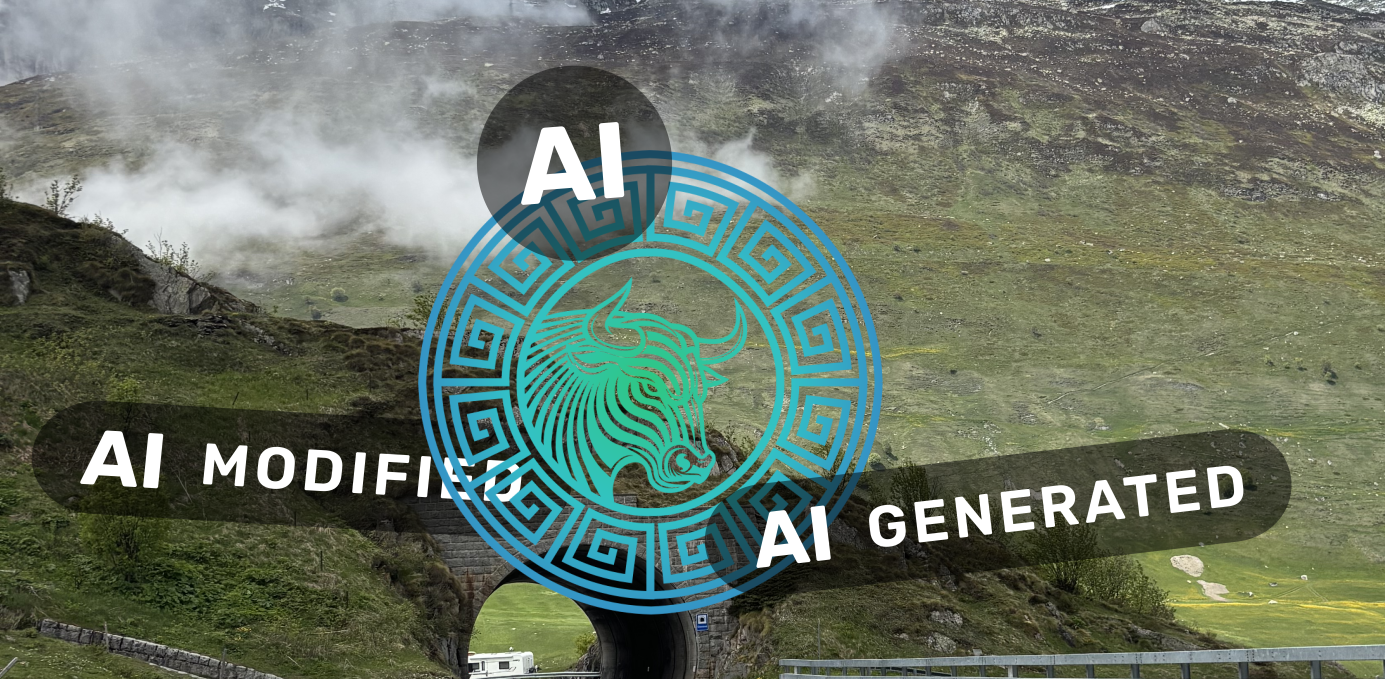
"Deployers of generative AI systems can use the EU set of icons to label certain AI-generated content, in accordance with the AI Act transparency rules."
From the European Commission website: EU Icons for labelling AI-generated content
Companies need to embed icons to show users that content is AI generated. The EU, as generous as they are, have provided these icons:



While compliance with transparency rules is mandatory for companies operating in the EU, using these specific icons is a voluntary, standardized option—developers can also use equivalent, standard disclosure methods.
And we think this is good as it directly combats the "slop-ification" of the content space, and subsequently hinders Dead Internet Theory. Heck, maybe we can even move towards an Alive Internet Theory.
Whilst these rules are slowly adapted by member states and companies, the EU's proactive stance on this matter sparked significant debate. Not necessarily due to the fact that folks are against this, on the contrary. Most consumers find this a step in the right direction.
Moreso that companies such as Anthropic are including watermarks in AI generated content. On first glance, invisible watermarks seem counterintuitive since humans can't spot them directly. However, Article 50 actually encourages machine-readable watermarking because it allows search engines to detect AI content automatically, even if a visual icon is cropped out. Still, this technology raises privacy and ownership debates; not only does this defeat the purposes of including them to limit consumer harm (and DIT!), but the community is also afraid that AI companies will retroactively use this to find out which content is made by them. This brings up privacy concerns but also would be a legal hell hole, as companies may say that everything coming out of their model is their property.
Now before we start getting the pitchforks out, as it stands no invisible watermark technology is foolproof, meaning that simple rewriting or editing fixes this issue. But it does set the precedent, what will the future hold?
Now that you are a bit wiser, we'd like to point out that Initium Strategies can help in adapting these rules! We believe that AI use should be transparent and as such, we are currently working on providing specific development services on AI transparency, follow us to see what we are cooking up!